The BOM Website Blowout | Lessons From Australia’s $97 million Website Mistake
5 min read | Published: Apr 27, 2026 | Last updated: Apr 27, 2026

Every so often, a number comes along that is so staggering it forces you to stop and question everything.
The recent revelation that the Australian Bureau of Meteorology (BOM) spent $96.5 million of taxpayer money on its new website is one of those moments.
Initially reported as a $4.1 million project, the true cost has sent shockwaves through the public and the digital marketing industry.
At Wolf IQ, we live and breathe web development and see firsthand the confusion and frustration that can sometimes surround website pricing.
But this isn't about a few thousand bucks; it's about almost $100 million invested and unfortunately one that failed some of its most critical user experiences.
Here is what it should have really cost and the lessons for business owners and marketing leaders.
Anatomy of a Government Website Disaster
To be fair, the BOM website is not a simple website.
It is one of Australia's most-visited digital assets, serving 18.3 million organic visits every month (or 600,000 people a day).
With an Authority Score of 85 from SEMRush and 1.4 million organic keywords ranking on Google - the BOM website is the authority for Australian Weather.
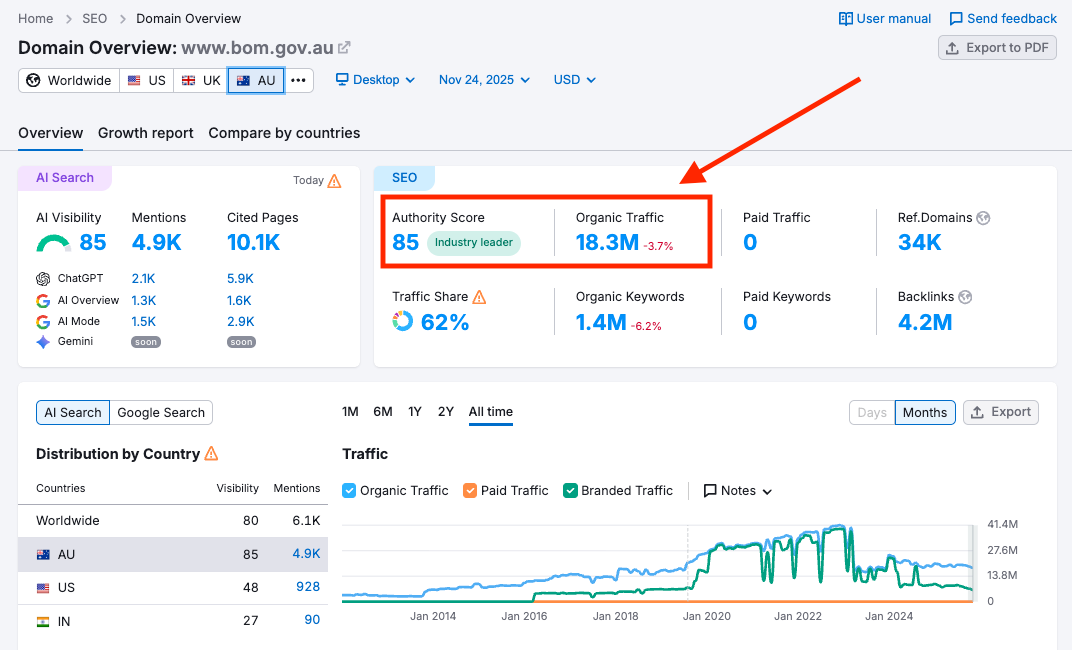
To put these numbers in perspective, global websites (like YouTube) are the most trafficked websites in Australia getting hundreds of millions of organic visits a month, while local players MyGov gets about 8 million organic visits a month.
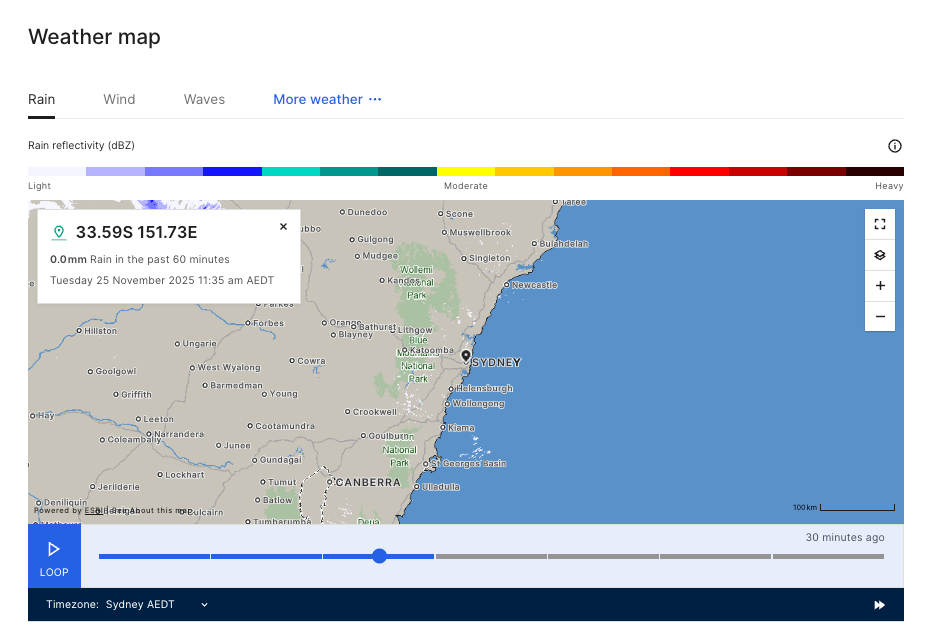
Not only does the BOM website get lots of traffic, it has a big digital footprint. The BOM website consists of over 400 pages and handles immense amounts of real-time data, from satellite feeds to local rain radar, and its accuracy is vital for Australian public safety and the agriculture industry.
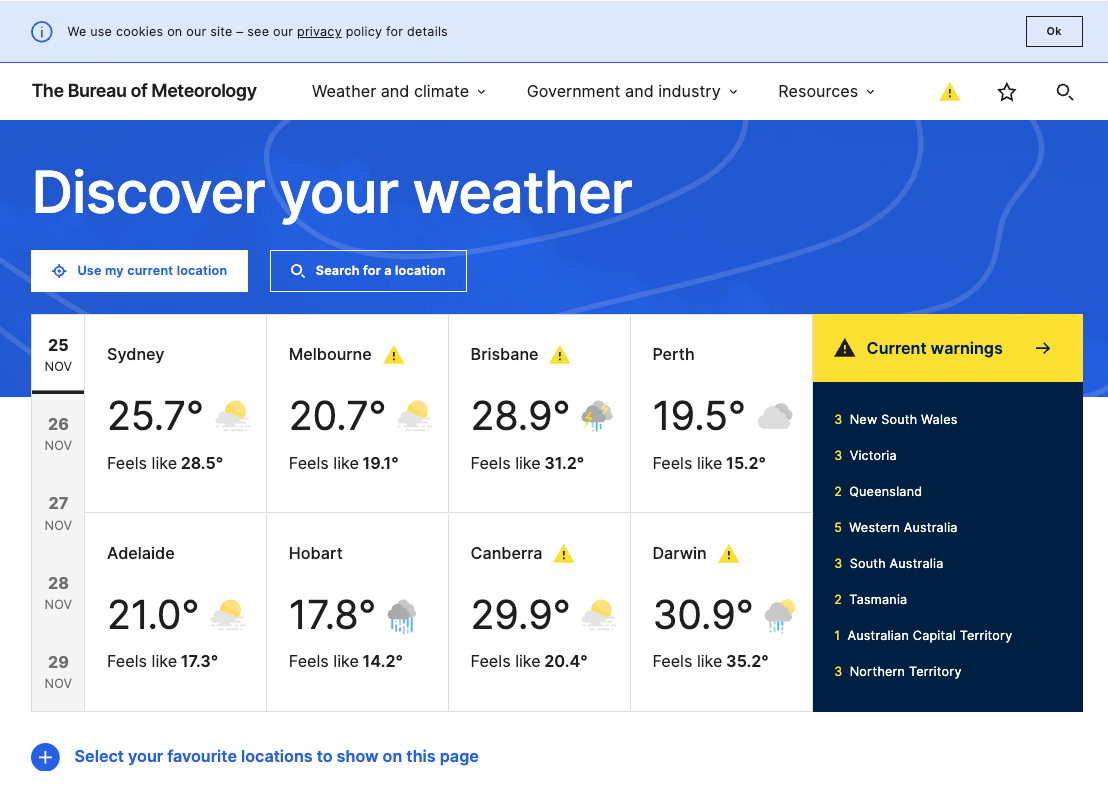
A big, complex website for sure - but complexity alone doesn't justify a $96.5 million price tag.
The project's reported cost breakdown is where the story begins to unravel:
- Website Redesign: $4.1 million
- Website Build: $79.8 million
- Launch & Security Testing: $12.6 million
Change is inherently difficult and people naturally resist it, but it seems that the BOM's changes unfortunately created panic in communities that rely on this data for their safety and livelihoods.
The launch was followed with lots of issues like:
- Farmers couldn't access vital rainfall data
- The new radar maps were confusing
- Basic functionality like searching by GPS coordinates was removed
The ABC interviewed Northern Victorian agronomist Malcolm Taylor who said ‘It's clearly been designed by IT nerds who've got no understanding of the client's needs.’ Ouch.
What should have the BOM Website Really Cost?
To understand what a project of this magnitude should cost, we need to break it down into its core components.
The BOM website is a complex ecosystem of real-time data, visualisations, and mission-critical information for thousands of businesses and millions of people around Australia.
Based on Wolf IQ’s analysis, a more sensible website cost based on the site's features and workstreams should have looked something like this.
| Component / Phase | Estimated Cost Range (AUD) | Key Activities & Complexities |
|---|---|---|
| 1. Strategy | $300,000 | This would involve conducting research with key user groups like Farmers (for planting/harvest decisions), Aviation pilots (flight safety), and Emergency Services (fire/flood response). The outcome is to design an architecture that prioritises impact above just updating the website. |
| 2. UX/UI Design | $500,000 | Crafting a user experience for millions of diverse users. Designing the complex interactive map interfaces, creating a full design system, and ensuring WCAG accessibility compliance. |
| 3. CMS Build | $500,000 - $1,000,000 | The BOM website is built on Drupal and WordPress. This step would be developing the main website structure, content pages, news sections and search functionality. |
| 4. Data & APIs | $1,000,000 | This is the heart of the project. Integrating the external software to ingest, process, and serve real-time data from weather stations, satellites, and forecast models. |
| 5. Interactive Maps | $500,000 - $1,000,000 | Developing a custom, layered map engine (like the wind/rain overlays) that runs smoothly on mobile devices. Ensuring the "play/pause" functionality for time-series weather events acts intuitively, allowing users to scrub through forecast models seamlessly. |
| 6. Infrastructure & Security | $500,000 | Configuring cloud infrastructure that can sit idle during calm weather but instantly scales 100x during a "Cyclone Ilsa" type event. Implementing government-level security (IRAP) without creating friction for the everyday user. |
| 7. Project Management | $500,000 | A phased rollout strategy that allows "power users" (mariners, farmers) to test the new system alongside the old one for 3 months. Creating educational content on how to read the new data visualisations before shutting down the legacy site. |
| Total Estimated Cost | $3,800,000 - $4,800,000 | A comprehensive, expert-led project delivering a world-class, reliable, and scalable digital service. |
This cost range of $3.8 to $4.8 million is slightly above the original government estimate of $4.1 million.
But the fact that the actual cost ballooned to almost 20x more points to some key lessons we can take away.
Four Key Lessons from the BOM Website
How can business owners and marketing leaders avoid a similar, albeit smaller-scale, disaster?
Here are four critical takeaways:
1. Define value before your budget
The first question should never be 'How much will it cost?' but 'What value must this deliver?'
If the BoM could articulate a clear ROI measured in public safety and reliability - the price tag may not have come under such scrutiny. For the 600,000 Australians who rely on this data daily for farming, transport, and emergency decisions, an investment of $10m or even $20m could be justified if it works.
The tragedy of the BoM website project is that it lost sight of its primary value: providing clear, accessible, and life-saving information. The $96.5m cost disclosure was the salt in the wound of the launch failure.
Before you spend a dollar, you must define what a successful outcome looks like for the people who actually use it.
2. Test with the right audience
BOM had the new website available for beta users for several months before launch, but evidently they didn't get the right feedback they needed to make the project a success.
A major failure point here appears to be conducting beta testing through obscure links rather than the actual end-users that relied on the BOM service.
When building a new website for your business, you can't rely on a friend to ‘look it over’ - you need real input from customers, and expert support to change and update the website from the feedback.
3. Complexity gets expensive
A website that handles real-time data visualisation, high-traffic APIs, and mission-critical alerts is not a standard web project.
Integrations are often one of the most expensive parts of a website’s cost and ongoing website maintenance - but this is often done by a handful of developers that bring the skills and knowledge. Even if they had 10 senior integration engineers being paid $200,000 a year, for two entire years - it would amount to only $4 million.
With almost $100 million spent, it's the classic footprint of a large professional services overhead where the budget can be consumed by management hierarchies rather than the developers actually building the website.
4. Project Management is Critical
Wolf IQ has built many government-grade websites with investments over $100,000, and the burden of communication and project management is a real and necessary investment.
With large projects, a dedicated Project Manager can be a most critical asset to keep the project on the rails. They ask the tough questions and steer the ship each day.
The decision-makers for the BOM website were likely not equipped to challenge the vendor, question the process, or recognise the red flags of a project getting out of control.
Once the website cost blew past $10 million invested (or double the estimate) - alarm bells should have been ringing to reassess the road ahead.
Being an Informed Website Buyer
When decision-makers - in business or government - lack understanding of what it takes to build a high-performing website, they can become vulnerable.
They often can't ask the right questions, they can't properly vet vendors, and they can't see the red flags of a project going off the rails.
At Wolf IQ, we believe in transparency and delivering value - and if you’re looking to build a website, we built a detailed guide that covers:
- Defining what your website truly needs to achieve
- Learning what drives costs and how to budget effectively
- Choosing the best approach: DIY, freelancer, or agency
- How to attract visitors that convert into leads / customers
- Understanding website maintenance and support requirements
Learn more with Wolf IQ's Website Buyer’s Guide.
Get started with a free consultation today
Don't just settle for a website. Thrive online with Wolf IQ.
Get in Touch Trusted by 500+ businesses
Education
Better resources, better decisions
Discover Wolf IQ's resource hub for articles and guides to growing your business online.
Is SEO Dead? What business owners need to know about Google's new AI Overview
With Google's AI Overviews taking over search, small businesses are shifting away from keyword chasing.
Learn More →
What is Local SEO and how does it work?
Local SEO helps businesses appear in searches relevant to their location, driving nearby customer traffic.
Learn More →
13 mistakes small business owners make with their website
Common website mistakes include slow load times, poor navigation, and weak calls to action.
Learn More →
Why does your website need to be mobile-first?
Mobile traffic now makes up the majority of website visitors. Here is what you need to know about responsive design.
Learn More →
8 Ways Small Business Owners Get Website Optimisation Wrong
Many small businesses overlook key factors like page speed, mobile responsiveness, and SEO, limiting their online impact.
Learn More →
What is Website Optimisation?
See some key examples where speed, design, and content can amplify your online success.
Learn More →